Quick Answer
Georgia ranks seventh in the country for net domestic migration, and a growing share of newcomers are landing east of Atlanta in Walton County. For most out-of-state buyers the move pencils out: a flat 4.99% state income tax, moderate property taxes (Walton runs about a 1.04% effective rate), a low 7% sales tax, and one of the most generous retirement-income exclusions in the nation. The honest catch is that the size of your win depends entirely on where you are moving from, and in Loganville the county line quietly decides your schools and your tax bill. Here is the full rundown.
Moving to Walton County From Out of State: The Honest Rundown
The tax math, the trade-offs, where buyers land in Loganville and Monroe, and the one thing almost nobody thinks to ask about until after they arrive.
Here is a stat that surprises people: Georgia gains more new residents from Florida than from any other state. Everyone pictures the retiree pipeline running south toward the beaches, but on net it runs the other way. Florida sent roughly 52,000 people to Georgia in a single recent year, and Georgia’s largest net population gain from any one state was with Florida. California and New York each land in the top seven origin states too, according to U.S. Census migration data. A lot of those newcomers are skipping the crowded core and heading for the quieter, faster-growing counties east of Atlanta. Walton County is right in the sweet spot.
After 19 years and 500-plus closings across the Atlanta-to-Athens corridor, we have helped a lot of out-of-state families make this move. Some of it goes exactly how they expect. Some of it does not. This is the honest rundown: the tax math, the trade-offs, where buyers tend to land, and one thing almost nobody thinks to ask about until after they arrive, which is what the county line does to your schools and your taxes.
The Tax Math Is Usually Where the Conversation Starts
So let’s do the numbers. The honest truth up front: how good the math looks depends heavily on the state you are leaving. Coming from a high-tax state, the savings are dramatic. Coming from a no-income-tax state, some of it flips. Here is how each piece works.
Income tax
Georgia charges a flat 4.99% state income tax (cut for 2026 under HB 463), and there is no county or city income tax stacked on top. Everyone pays the same flat rate. If you are coming from California, where the top rate reaches 13.3%, or New York, New Jersey, or another high-bracket state, that is a meaningful cut every single year. If you are coming from Illinois at a 4.95% flat rate, it is close to a wash. And if you are coming from Florida, Texas, or Tennessee, where there is no state income tax at all, this is a new line item you did not have before. Know which camp you are in before you assume anything.
Property tax
This is where the Northeast and Midwest transplants feel the relief. Walton County’s effective property tax rate runs around 1.04% of value, close to the national median. On a $450,000 home, that is roughly $4,600 a year before you apply your homestead exemption, and Georgia’s homestead exemptions plus the new statewide assessment cap under HB 581 pull the effective number down further for owner-occupants. Compare that to New Jersey or Illinois, where the same-priced house can carry a $9,000 to $11,000 annual bill, and the gap over a decade of ownership buys a car. California buyers are the exception here: thanks to Proposition 13, their rate is actually lower, so for them the win shows up in the home price and the income tax, not the property tax rate.
Sales tax
Here Georgia is friendlier than a lot of people expect. The combined sales tax in Walton County is 7% (4% state and 3% local). Georgia exempts groceries from the 4% state portion, though the 3% local piece still applies at the register. Seven percent is low by national standards and well below neighboring states like Tennessee, which runs close to 9.75%. So unlike some destinations, the sales tax is not the hidden catch here.
Retirees, read this part
If you are retired, Georgia is one of the most generous states in the country. Social Security is fully exempt at every age. On top of that, residents age 62 to 64 can exclude $35,000 of retirement income per person, and residents 65 and older can exclude $65,000 per person, per the Georgia Department of Revenue. For a married couple both over 65, that is up to $130,000 of retirement income sheltered from state tax every year. For a lot of retirees, that exclusion alone is the reason the move makes sense.
The honest catch: Georgia’s property taxes are moderate, not rock-bottom. Groceries still carry the 3% local sales tax. And if you are leaving a no-income-tax state, you are adding a 4.99% line you did not pay before. For nearly every working household moving from a high-tax state the math still favors Georgia by a wide margin. But run your own numbers before you assume, and talk to your accountant.
Curious what your money buys here, or what your current home is worth?
Get a free, instant home-value estimate and track the market before you list or buy.
What Actually Gets Better, and What You Will Miss
We would rather you hear this from us than discover it in July.
Better
Your housing dollar. In and around Loganville and Monroe, the typical home sits in the low-to-mid $400,000s, and you get real square footage and real lot size for it. Buyers coming from coastal metros or the Northeast are usually stunned by what that number buys here.
Mild winters and four real seasons. It gets cold, but it is measured in days, not months. Spring shows up early and means it.
Two anchors, one location. You are roughly 45 to 60 minutes from Atlanta, its job market, and Hartsfield-Jackson, the busiest airport in the world, and about 30 minutes from Athens, home to the University of Georgia, a growing healthcare hub, and SEC Saturdays.
Room to breathe. Walton County still has land, small-town squares, state parks like Hard Labor Creek, and a pace that the inner suburbs traded away years ago.
What you will miss
Transit and walkability. MARTA does not reach Walton County. This is car country, full stop, and the drive into Atlanta on Highway 78 or I-20 at rush hour is real. If you are coming from a city where you did not own a car, that is the biggest adjustment.
Big-city amenities on your doorstep. The towns are small and charming, but for pro sports, major concerts, and a huge dining scene you are driving to Atlanta or over to Athens.
The summer trade. July and August are hot and humid. You are swapping snow for humidity. Most transplants call it a win, but it is a trade.
Coast and mountains are a drive. The ocean is about four and a half hours away and the North Georgia mountains about an hour and a half to two hours. Great for weekends, not for a Tuesday.
Where Out-of-State Buyers Tend to Land
Walton County has a handful of towns worth knowing, but the two that out-of-state buyers ask us about most are Monroe and Loganville. They pull very different kinds of buyers.
Monroe: the one with a real downtown
If you want a historic, walkable town center, Monroe is the pick. As the Walton County seat, it has a genuine downtown square lined with brick storefronts, antique shops, restaurants, and festivals, along with blocks of restored Victorian homes and a working small-city core with its own hospital and government. Most single-family buyers land somewhere in the $350,000 to $550,000 range, with historic-district homes and new construction running above that. It is about 50 minutes to Atlanta and 30 minutes to Athens, and it is anchored by Walton County Schools. Read our full Monroe, GA guide for the neighborhoods and current market.
Loganville: closer to Atlanta, but check the county line
Loganville is the shorter-commute play. It sits on Highway 78 toward the Gwinnett job centers and Atlanta, with a mix of newer subdivisions and some acreage, and a typical home value right around $400,000. It is popular with buyers who still work toward the metro. Our Loganville guide covers it in depth, and if you are looking at the eastern edge, see our piece on living along Grady Smith Road.
The one thing every out-of-state buyer needs to know about Loganville
Loganville straddles the Walton and Gwinnett county line. That is not a technicality. It quietly changes two of the most important things about your home.
Schools: homes on the Walton County side are zoned to Walton County Schools. Homes on the Gwinnett County side are served by Gwinnett County Public Schools, one of the largest and most-awarded districts in the state, through schools like Grayson and South Gwinnett High. Two houses a few streets apart can attend entirely different districts.
Taxes: the Gwinnett side carries its own city and county tax structure, including a separate Loganville city bill (around 9.869 mills) that does not show up in Walton County’s published rate. Same city name, different total tax bill.
The rule: never buy in Loganville off the city name alone. Verify the county, the school zone, and the full tax bill by exact address. This is the single most common thing new arrivals get surprised by, and it is completely avoidable.
Prefer more space or a lower price per acre? The eastern and southern parts of the county, including Good Hope, Between, and Walnut Grove, are the land-and-value play, and Social Circle offers a small historic city with its own well-regarded city school system. Start with our Social Circle guide or the full Walton County real estate overview.
The Part Nobody Puts in the Brochure: Politics and Fit
We bring this up because out-of-state buyers increasingly ask, and because it is better to know before you buy than after.
The short version: Walton County is strongly Republican, and the metro core and the Athens end of the corridor lean the other way. In the 2024 presidential election, Walton County voted about 73% Republican, roughly three to one, well above the statewide split. By contrast, Athens-Clarke County (home to the University of Georgia) votes heavily Democratic, DeKalb County toward Atlanta is strongly Democratic, and Gwinnett County has shifted Democratic in recent cycles. Newton County, just south, is more competitive.
None of that tells you whether you will like your neighbors. It does tell you something about the general temperature: the yard signs, the school board meetings, the default assumptions at a backyard cookout. If you lean conservative, the Walton County towns will feel like home quickly. If you lean progressive and want to live somewhere that votes the way you do, the in-town options in this corridor are Athens at the east end and the DeKalb and Decatur area toward Atlanta. Plenty of people happily cross these lines in both directions, and nobody is checking voter registrations at the property line. But if political fit matters to you, county lines are the honest shorthand, and we would rather tell you plainly.
Schools: The Question Behind a Lot of These Moves
A large share of families moving here are moving for schools, whether they say so up front or not. The quick orientation:
Walton County Schools anchors Monroe, the Walton side of Loganville, and the smaller communities like Good Hope, Between, and Walnut Grove. It is a solid, growing suburban district. Social Circle City Schools is a small, separate, well-regarded city system on the county’s south side. On the Gwinnett side of Loganville, Gwinnett County Public Schools takes over, and it is one of the largest and most decorated districts in Georgia. Newton County Schools serves the Covington side to the south.
And once more, because it is the mistake we see most: in Loganville, the county line is the school line. Verify by address before you fall in love with a house.
How the Move Itself Usually Goes
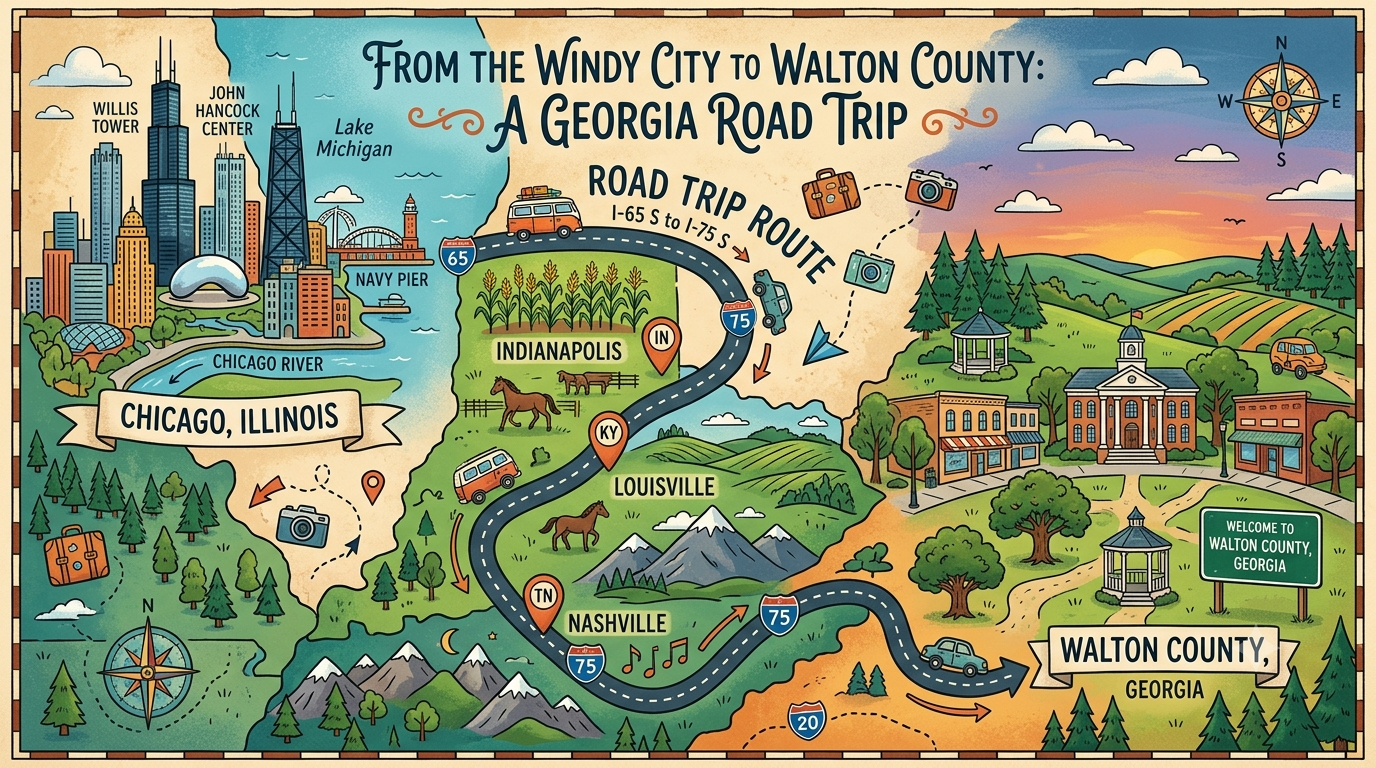
The drive depends on where you are starting. From Florida it is a half-day down I-75. From the Northeast or Midwest it is one to two days. Either way, most of our out-of-state clients make one or two scouting trips, and we handle a lot of the legwork in between: video walkthroughs on the ground, honest neighborhood reads, and market data pulled straight from the MLS through eastgahomes.com rather than national sites that lag weeks behind.
A few practical notes. Once you land, Georgia expects you to get a Georgia driver’s license and register your vehicles within 30 days, and register to vote. File for your homestead exemption by April 1 to have it apply for that tax year; Georgia’s new HB 581 also adds a floating homestead assessment cap in participating jurisdictions (Walton County participates) that limits how fast your assessed value can climb. And if you are selling a home in another state, understand the timing and any exit taxes before you close here. Talk to your accountant before you list. We are happy to point you to local ones who handle relocations all the time.
Why relocating families trust the Davis Team
Start your relocation plan | Call or text Chris at 770-833-5965
Frequently Asked Questions

Chris Davis, REALTOR® | The Davis Team at Keller Williams Atlanta Partners
Chris has spent 19-plus years and 500-plus closings helping buyers and sellers across the Atlanta-to-Athens corridor, including Loganville, Monroe, Social Circle, and the rest of Walton County. He specializes in relocations and knows exactly which side of the county line you are standing on. Call or text 770-833-5965 or email chris@eastgahomes.com.
Disclaimer: This article is for general information only and is not tax, legal, or financial advice. Tax rates, millage rates, exemptions, school zoning, and market figures change and vary by property and jurisdiction. Migration and tax figures are drawn from the U.S. Census Bureau, the Georgia Department of Revenue, and county sources as of 2026. Always verify county, school zone, and tax details by exact address, and consult a licensed accountant or attorney for your situation. Chris Davis is a licensed Georgia REALTOR® (GA License #327023), not a tax advisor or attorney.