Quick Answer
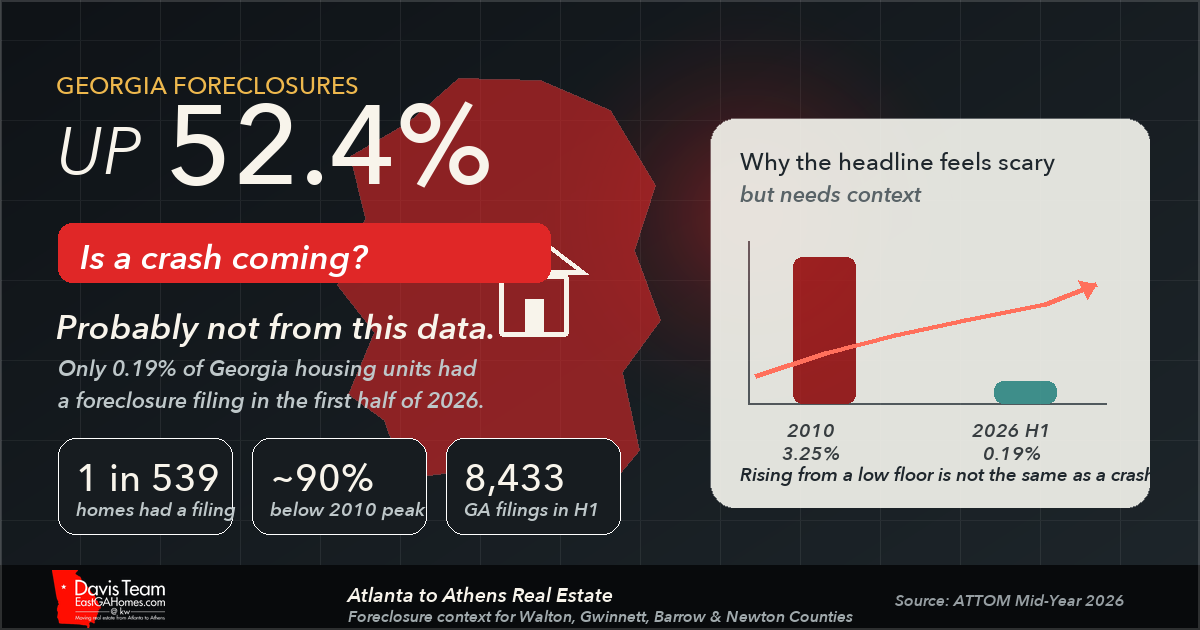
Georgia foreclosure filings rose 52.4 percent in the first half of 2026, and foreclosure starts rose 23.3 percent, according to ATTOM’s Mid-Year 2026 U.S. Foreclosure Market Report. That sounds alarming, but the percentage is large because the starting point was tiny. Only 0.19 percent of Georgia housing units, about one in every 539 homes, had any foreclosure filing in the first six months of 2026. In 2010 that figure was 3.25 percent, roughly one in every 31 homes. Today’s activity is still running close to 90 percent below the crash-era peak, homeowner equity is near record levels, and the increase is concentrated in FHA and VA loans rather than spread across the whole market. This is a market normalizing after pandemic-era foreclosure pauses, not a market collapsing.
ATTOM Mid-Year 2026 Foreclosure Report
Georgia by the Numbers, January through June 2026
Source: ATTOM Mid-Year 2026 U.S. Foreclosure Market Report, released July 16, 2026. Historical 2010 rate via RealtyTrac year-end data.
My phone started buzzing about ten days after the ATTOM numbers hit. Same question, different wording each time. “Chris, I saw Georgia foreclosures are up 52 percent. Should I be worried? Should I sell now before it all falls apart?”
Fair question. And I want to give you a real answer, not a cheerleader answer. I closed more than 1,000 REO and foreclosure transactions during the last crash and completed over 4,000 BPOs for banks and asset managers. I spent years walking into houses where families had lost everything. I know exactly what a genuine foreclosure wave looks like from the inside, and I have a pretty good sense of what one does not look like.
So here is the honest version. The 52 percent number is real. It is also one of the most misleading real estate headlines of the year, and once you see why, you will stop losing sleep over it.
What Did the ATTOM Report Actually Say About Georgia?
Two different Georgia numbers are floating around, and people keep mixing them up. They measure different things.
The first is total foreclosure filings, which counts every property that got any kind of foreclosure document during the period. That includes default notices, scheduled auctions, and bank repossessions. Georgia recorded 8,433 of those in the first half of 2026, up 52.4 percent from a year earlier and up 59.4 percent from two years earlier. That is the number in most of the news coverage.
The second is foreclosure starts, which counts only properties where the process kicked off fresh during the period. Georgia had 8,164 starts, up 23.3 percent from 6,259 in the first half of 2025. On raw volume that ranks Georgia fourth in the country behind Texas, Florida, and California, which is roughly where you would expect a state with our population.
Nationally, ATTOM counted 227,548 properties with filings and 164,566 starts, up 21 percent and 18 percent respectively. So Georgia is running hotter than the national average. That part is true and worth understanding.
But notice what is missing from every headline: the denominator. Georgia’s 8,433 filings represent 0.19 percent of all housing units in the state. One in every 539 homes. Statewide. Over six months. Georgia ranked 11th nationally by rate, well behind Florida at 0.27 percent, South Carolina at 0.26 percent, and Indiana at 0.25 percent.
Put that in neighborhood terms. If you live in a 200-home subdivision in Loganville, Monroe, or Grayson, the statewide rate works out to roughly one home in your entire neighborhood picking up a foreclosure filing over a six-month stretch. That is not a wave. In 2009 I was working entire streets.
Why Does a 52 Percent Jump Not Mean a Crash?
Because percentages lie when the base is small. If a number goes from two to three, that is a 50 percent increase. Nobody panics. If foreclosure filings go from 5,533 to 8,433 in a state with about 4.4 million housing units, that is also a big percentage and a genuinely small absolute change.
The comparison that actually matters is where we sit against the real crash. Here is what that looks like.
| Measure | 2010 Peak | First Half 2026 |
|---|---|---|
| Georgia foreclosure rate | 3.25% of housing units | 0.19% (six months) |
| Georgia homes affected | About 1 in 31 | 1 in 539 |
| U.S. properties with filings | About 2.87 million (full year) | 227,548 (six months) |
| U.S. homes seriously underwater | Roughly 1 in 4 at the worst of it | 3.2% |
Even if you annualize the 2026 half-year rate, Georgia lands somewhere around 0.4 percent for the full year. That is roughly 88 percent below where we were in 2010. We are not close. We are not trending close. We would need this current rate to multiply eight or nine times over before the comparison even becomes interesting.
What Is Actually Driving the Increase?
Four things, and none of them are “the housing market is breaking.”
1. We are still catching up from the pandemic pause
Foreclosure moratoriums and forbearance programs froze this entire pipeline for roughly two years. Filings dropped to under 200,000 nationally in 2020, which was never a real number. It was a policy number. Everything since 2022 has been the system slowly refilling to normal, and ATTOM’s own CEO Rob Barber described the first half of 2026 as a market gradually returning to more typical patterns.
Supporting evidence for that read: the average time to complete a foreclosure fell to 563 days in the second quarter of 2026, the lowest since 2013 and the seventh straight quarterly decline. Backlogs clearing is what causes filing counts to rise on paper. A collapse in borrower finances would show up very differently.
2. It is an FHA and VA story, not a whole-market story
This is the single most important thing in this entire post, and almost nobody is reporting it.
The Mortgage Bankers Association’s National Delinquency Survey for the first quarter of 2026 put the overall delinquency rate at 4.44 percent. Sounds like broad stress. Then you break it apart by loan type and the picture completely changes. Conventional loan delinquencies actually fell 14 basis points to 2.75 percent. FHA delinquencies climbed to 11.88 percent. VA delinquencies rose too.
In plain English: the borrower who put 20 percent down on a conventional loan is doing fine. The stress is concentrated in low-down-payment government-backed loans, particularly purchases from 2022 through 2024 where buyers stretched, put three and a half percent down, and have not had time to build a cushion.
There is also a technical wrinkle worth knowing. Pandemic-era FHA relief options expired at the end of September 2025, and FHA borrowers working through required trial payment plans still count as delinquent in the survey until a permanent workout is finalized. So part of what looks like deterioration is a change in how loans get counted, not families going under.
3. Georgia’s foreclosure process is one of the fastest in America
Georgia is a non-judicial foreclosure state. A lender does not have to file a lawsuit or stand in front of a judge. Under O.C.G.A. § 44-14-162.2 the lender sends written notice at least 30 days before the sale, advertises in the county legal organ once a week for four consecutive weeks, and sells on the courthouse steps the first Tuesday of the month.
That structural speed matters enormously for interpreting this data. In New York the average completed foreclosure took 2,007 days in the second quarter. In Louisiana, 3,491 days. Georgia files fast and finishes fast, so distress surfaces in the statistics almost immediately instead of getting stuck in a court queue for five years. Our number looks worse partly because our system is more efficient, not because our homeowners are in worse shape.
4. Carrying costs went up faster than paychecks
Homeowners insurance, property taxes, and HOA dues have climbed hard across the Southeast. A family who qualified comfortably in 2022 at one escrow payment may be looking at a very different number today with the same loan. That is a real squeeze and it deserves to be taken seriously. It is also a fundamentally different problem from 2008, when the loans themselves were the bomb.
Is This Anything Like 2008?
No, and I want to be precise about why rather than just saying it confidently.
The 2008 crisis had three ingredients working together. Loans were underwritten with essentially no verification. A huge share of borrowers had zero or negative equity. And when prices fell, walking away was the rational financial move for millions of people, which fed more supply into a falling market and made everything worse.
Check those against today.
Underwriting. Post-2010 rules require documented income and ability to repay. The stated-income, no-doc, negative-amortization products that fueled the crash are simply not being originated at scale anymore.
Equity. ATTOM’s first quarter 2026 data shows 43.3 percent of mortgaged homes are equity-rich, meaning loan balances are under half the home’s value, while just 3.2 percent are seriously underwater. Compare that to the end of 2019, when only 26.7 percent were equity-rich and 6.5 percent were underwater. We are in far better shape now than we were before the pandemic, let alone before the crash.
Household balance sheets. The June 2026 ICE Mortgage Monitor puts total homeowner equity near $17 trillion with roughly $11 trillion of that tappable. Millions of owners are also locked into first mortgages well below current market rates, which is a powerful reason to hold rather than sell.
Here is the practical consequence of all that equity, and it is the part I most want you to understand. A homeowner with equity almost never goes to auction. They sell first. If you are three payments behind on a Loganville house you bought in 2019 and you have $140,000 in equity, foreclosure would be financially insane. You list it, you sell it, you walk away with your money and your credit intact.
That is why foreclosure activity does not translate into a price crash in an equity-rich market. The 2008 death spiral required people to be trapped. Today most of them are not.
Know Your Number
How Much Equity Are You Actually Sitting On?
Every argument above depends on one number, and it is a number most homeowners are guessing at. Pull your current value and equity position in about thirty seconds. Free, no obligation, and I do not call you unless you ask me to.
What Does This Mean in Walton, Gwinnett, Barrow, and Newton Counties?
Georgia has 159 counties. Those 8,164 foreclosure starts are spread across all of them, and they are not spread evenly.
Worth noting from the ATTOM report: the Georgia metro that showed up on the national worst-rates list was Macon, at 0.36 percent, ranking fourth worst in the country among metros over 200,000 people. Metro Atlanta as a whole did not crack that top ten. Distress in Georgia is concentrated in specific pockets, and the Atlanta to Athens corridor is not one of them.
What I am seeing on the ground across Walton County, Loganville, Monroe, Snellville, and Winder is not distressed inventory piling up. It is a normal market with normal negotiation. Homes priced correctly still move. Homes priced on 2022 nostalgia sit, get a price cut, then sell. That has been the pattern for two years now and this report does not change it.
If a genuine distressed wave were building here, I would tell you. I have every professional incentive to be the guy who saw it coming, and frankly the REO side of my business would benefit. It is just not what the data shows.
What Should You Do If You Are the One Falling Behind?
Statistics are cold comfort if you are one of the 8,164. So let me talk directly to you for a minute, because Georgia’s speed cuts both ways and time is the resource you cannot get back.
If You Are Behind or About To Be
1. Open the mail. I mean it. The single most common thing I saw during the last crash was people who stopped opening envelopes. That certified letter starts a 30-day clock, and once the legal ad runs four weeks, the courthouse steps come fast.
2. Call your servicer before you are 120 days late. Federal rules generally block foreclosure from starting before 120 days of delinquency. That window is your negotiating room. Loss mitigation, repayment plans, and partial claims are all real options, and a complete loss mitigation application submitted before the first foreclosure filing triggers protections that stop the process while it is reviewed.
3. Talk to a free HUD-approved counselor. Not a company that found you through a mailer. Use the CFPB housing counselor directory or HUD’s counseling network. It costs nothing.
4. Find out what you own before you assume you own nothing. This is where most people get it wrong. After the run-up in values since 2020, an enormous number of homeowners who feel underwater are actually sitting on six figures of equity. Selling on the open market lets you keep that money. A foreclosure sale hands it to the lender and wrecks your credit for seven years. Same house, wildly different outcome.
My wife and I are both certified short sale experts, and I have handled more distressed transactions than most agents will see in a career. If you are in a tight spot, call me at 770-833-5965. That conversation is free and it is confidential, and sometimes it takes ten minutes to figure out you have more options than you thought. If speed is what you need, I can also walk you through a cash offer scenario and show you honestly what it costs you versus a traditional sale.
What About Buyers Hoping for Foreclosure Bargains?
I get this call constantly, so let me manage expectations.
Lenders repossessed 27,983 properties nationally in the first half of 2026. That is up 33 percent year over year, and it is still down 26 percent from the first half of 2020. Georgia did not appear on the top five list of states by REO volume. There is no flood of bank-owned inventory coming to Walton or Gwinnett County.
And remember the equity math from earlier. When a distressed owner has equity, the house hits the MLS at market value and sells like any other listing. The properties that actually reach the courthouse steps tend to be the ones with title problems, severe deferred maintenance, occupants still inside, or no equity at all. Buying at a Georgia foreclosure auction means cash on the spot, no inspection, no title insurance, and no right of redemption for you to lean on if something goes sideways.
Can it be done profitably? Absolutely, I have done it hundreds of times. But it is a business, not a shortcut to a cheap house. If you want to look at what is genuinely available, my foreclosure and HUD home page explains how the process actually works around here, and you can search live listings anytime at eastgahomes.com.
The Bottom Line
Georgia foreclosure activity is rising. That is true and I am not going to sugarcoat it, because some families are genuinely hurting and pretending otherwise helps nobody.
But rising from a historically low floor is not the same thing as a crash. We are running near 90 percent below the 2010 peak. Underwriting standards are strict. Equity is near record levels. The increase is concentrated in a specific slice of government-backed lending, partly for accounting reasons. And foreclosure timelines are shortening, which is what a clearing backlog looks like, not what a building crisis looks like.
If you were thinking about selling, do it because it fits your life, not because a headline scared you. Panic selling into a normal market is how people lose money.
Why Take My Word On Foreclosures
Georgia Foreclosure Questions, Answered

About the Author
Chris Davis, REALTOR®
Chris leads the Davis Team at Keller Williams Atlanta Partners, serving the Atlanta to Athens corridor across Walton, Gwinnett, Barrow, Newton, Oconee, DeKalb, and Jackson counties. With 19 years in the business, over 500 homes closed, more than $150 million in career volume, and over 1,000 REO and foreclosure closings during and after the last housing crisis, he has seen this market at its worst and at its best. He is also a certified short sale expert.
Call or text 770-833-5965 or email chris@eastgahomes.com. Georgia License #327023.
Disclaimer: This article is provided for general informational purposes only and does not constitute legal, tax, or financial advice. Foreclosure data is sourced from ATTOM's Mid-Year 2026 U.S. Foreclosure Market Report, the Mortgage Bankers Association's First Quarter 2026 National Delinquency Survey, and the June 2026 ICE Mortgage Monitor. Market conditions change and individual circumstances vary. If you are facing foreclosure, consult a licensed Georgia attorney and a HUD-approved housing counselor regarding your specific situation. Chris Davis is a licensed Georgia REALTOR®, not an attorney or financial advisor. Equal Housing Opportunity.