Quick Answer
$128.6M warehouse. ICE plan collapsed. Now it’s for sale.
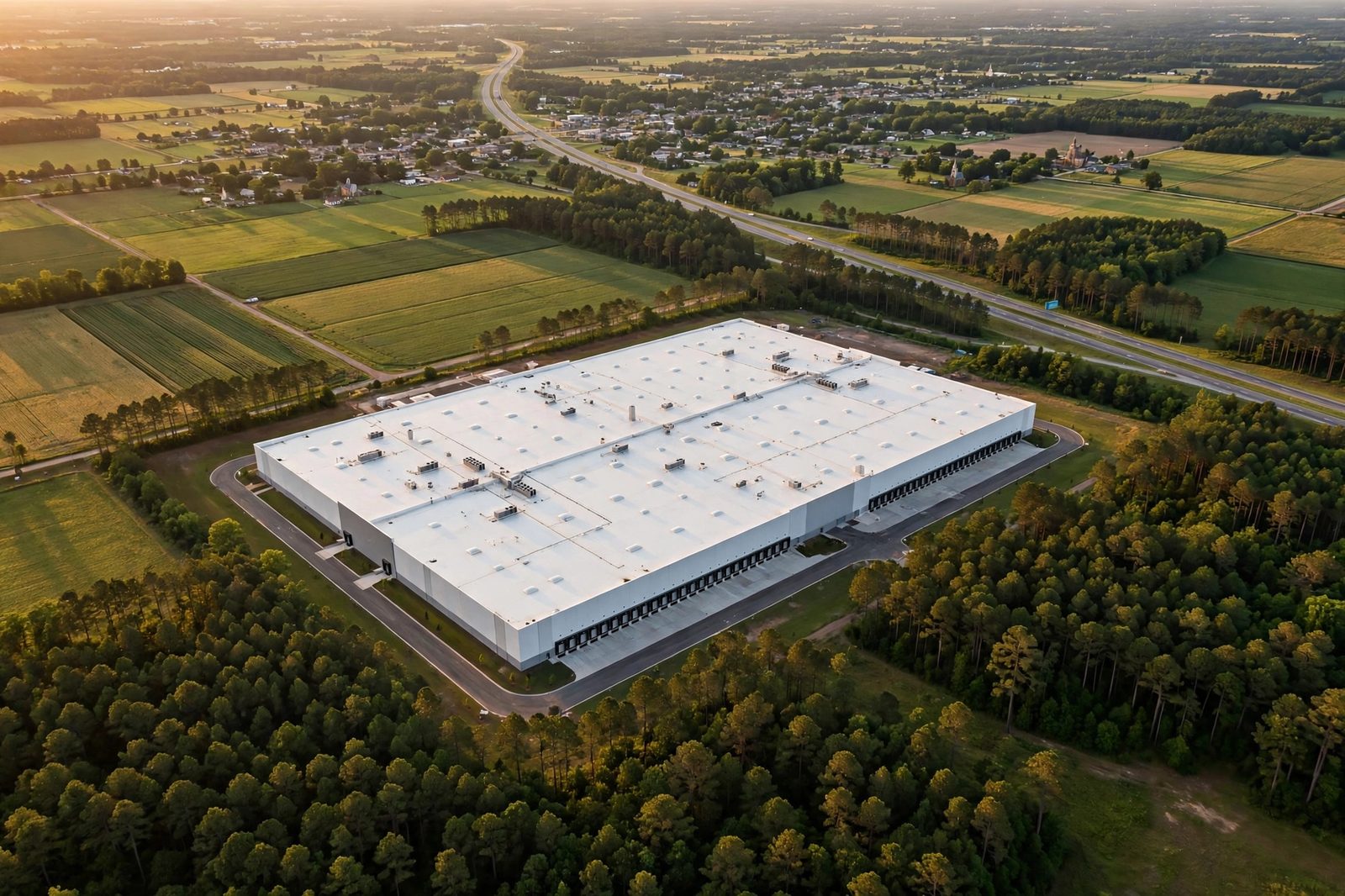
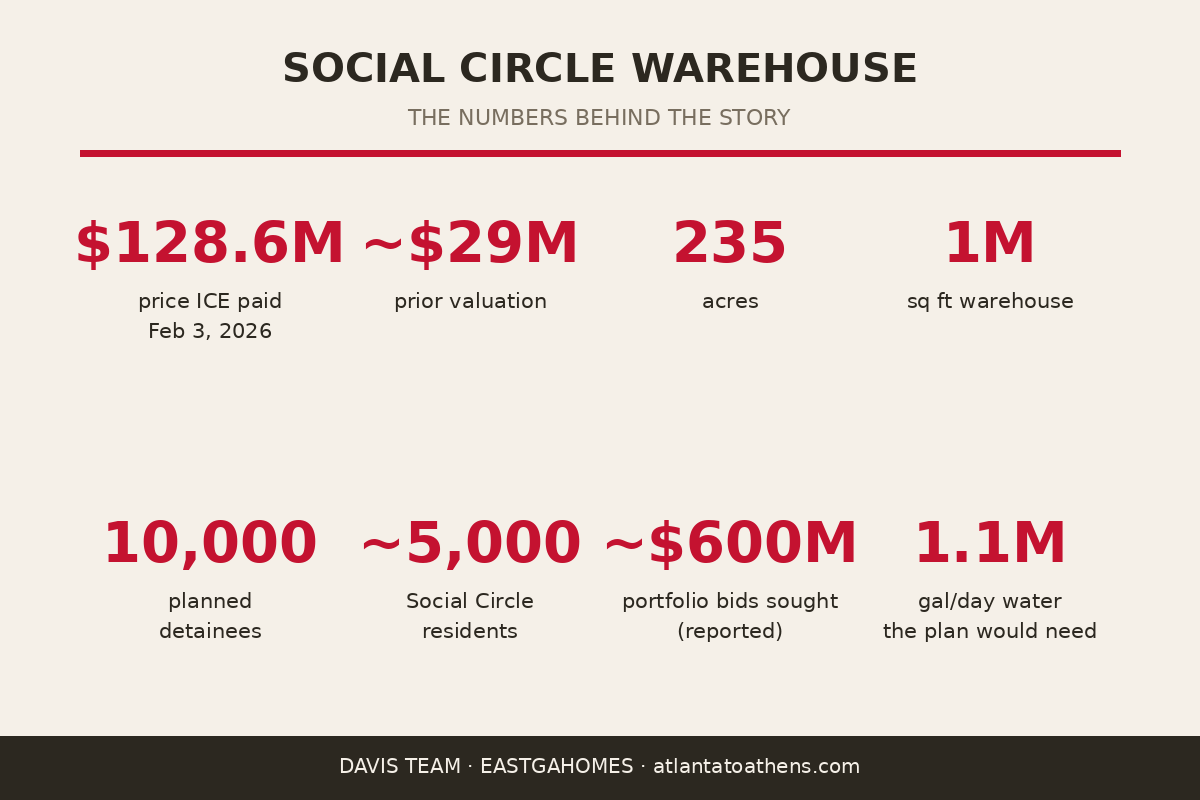
On February 3, 2026, the federal government paid $128,555,500 for a roughly one-million-square-foot warehouse on 235 acres at 1365 East Hightower Trail in Social Circle — intending to convert it into one of the country’s largest ICE detention facilities, with capacity for up to 10,000 detainees. Social Circle, a city of about 5,000 people, fought the plan in court. The project collapsed. And in early October 2026, the property officially hit the market as part of Cushman & Wakefield’s “Federal Warehouse Portfolio.”
For Walton County homeowners and buyers, the biggest headline is this: the scenario that had nearby residents worried — a facility holding twice the city’s population — is off the table. What replaces it is now the open question.
The Timeline
What Happened: The Timeline
- February 3, 2026 — The federal government buys the warehouse from PNK S1, LLC for $128,555,500. The seller had previously valued the property at roughly $29 million.
- February 2026 — City Manager Eric Taylor warns federal officials the city’s infrastructure can’t support the plan. The city locks the warehouse’s water meter.
- May 13, 2026 — Social Circle files a federal lawsuit against DHS and ICE (No. 3:26-cv-00054-TES, Middle District of Georgia), alleging officials skipped proper environmental review and ignored infrastructure impacts.
- June 18, 2026 — The city announces DHS is no longer pursuing the detention facility.
- September 10, 2026 — A federal judge stays the lawsuit for 60 days, barring any conversion of the property during the stay. A joint status report is due around November 9.
- September 24, 2026 — The Government Accountability Office reports the government spent $1.07 billion on 11 warehouses from January to April, with $20–20.5 million in unrecoverable expenses (due diligence, security, utilities).
- October 6, 2026 — Project Salt Box reports seven of the warehouses are being marketed for sale, below what the government paid.
- October 7, 2026 — The Walton Tribune confirms the Social Circle warehouse is for sale through the private market. The same day, ICE sends the city a formal letter proposing the site be sold as excess federal property, opening a 30-day public comment period (reported by FOX 5 Atlanta).
- October 19, 2026 — The first offer date arrives for the Romulus, Michigan property in the portfolio. The Social Circle offer date is still TBD.
The Price
The $100 Million Question: Did the Government Overpay?
This is the part of the story that refuses to die — and it’s the most repeated fact in every comment thread. The deed shows $128,555,500. The prior valuation was roughly $29 million (a $29.4 million 2023 sale, and a ~$29.8 million 2025 assessment cited by CNN, The Guardian, and the city’s own complaint). That’s roughly 4.3 to 4.4 times the earlier figure.
The pattern wasn’t unique to Social Circle. The federal warehouse buying spree produced some eye-watering comparisons: at Flowery Branch, Georgia, the government reportedly paid $68.2 million for a warehouse the seller had bought for $1.99 million two months earlier. In Socorro, Texas, roughly $123 million against a prior valuation near $11 million. One counterweight worth noting: CoStar, via Bisnow, put the portfolio’s premium at 11–13% over market price — a different baseline than old tax assessments, so the “4x” framing is one way to look at it, not the only one.
Now the government wants out. The seven properties are being marketed together — more than 5.3 million square feet across Georgia, Michigan, Pennsylvania, Texas, and Utah — and no asking prices have been publicly disclosed. But Green Street News, via Commercial Observer (September 30), reported that bids are being sought starting around $114 per square foot — roughly $600 million for the portfolio, about 15% below the ~$706.5 million the government paid. Translation: taxpayers are positioned to take a loss, and the size of it won’t be known until the sales close.
The Comments
What 722 Locals Actually Said in the Comments
I pulled 722 unique public comments across Facebook, Instagram, and Threads — from FOX 5 Atlanta’s sale post to the City of Social Circle’s own page back in February — and they break into five camps. The debate is livelier than the headlines suggest.
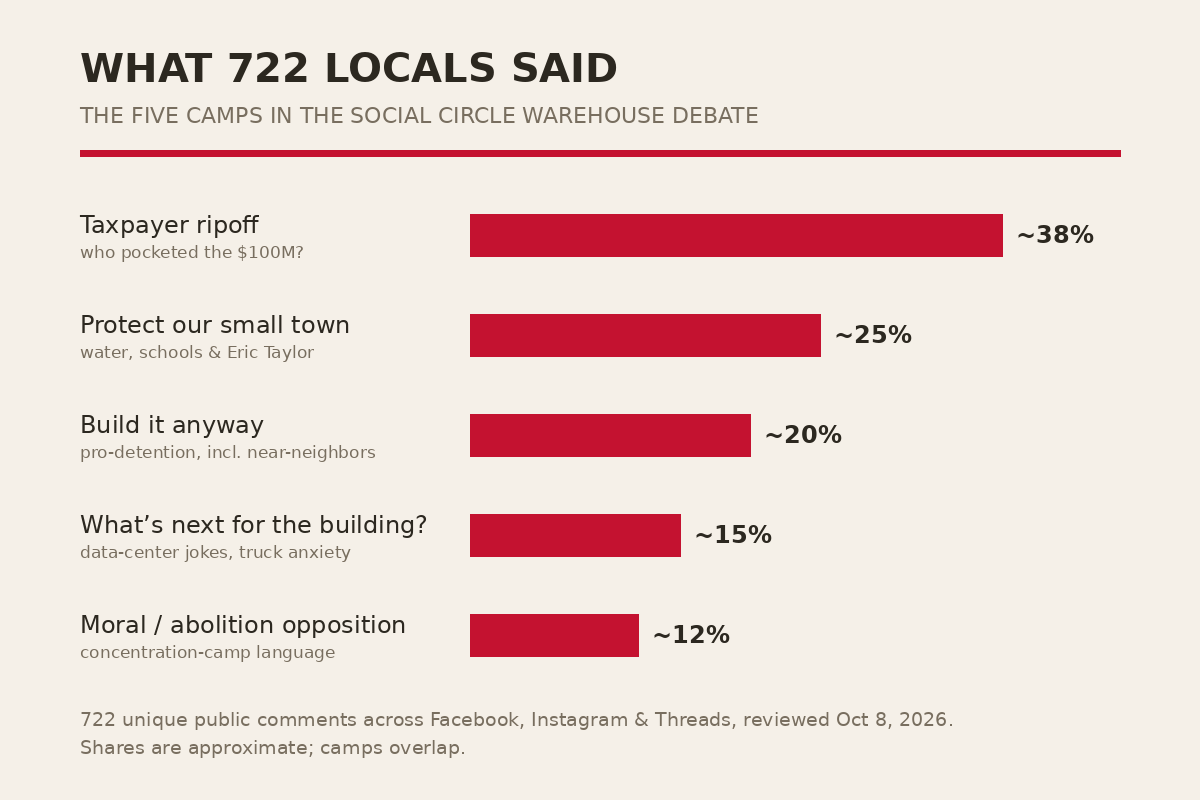
This is the outrage engine, and it dominates the October sale news. “Taxpayers are going to take a beating on this sale. Before DHS bought it, it was appraised at around $30M. DHS paid around $129M. It will be interesting to see how much it sell for,” wrote one commenter on FOX 5 Atlanta’s post. Another: “So glad our $100 million of our tax dollars was just thrown away. We overpaid for the building by that much. I thought Republicans were supposed to be into fiscal responsibility. At least it won’t be used as a concentration camp.” The corruption framing runs hot: “Money laundering. They’re moving our tax dollars from us to their cronies. Thieves.”
This is the local camp, concentrated in the February–June posts, and it’s mostly infrastructure math, not partisanship. “Eric Taylor is doing his job, protecting the City’s infrastructure since it cannot support the demand this facility will create. Thank you sir!” (Walton Tribune, March 13). The water numbers were the whole argument: a facility needing roughly 1.1 million extra gallons of water a day in a city whose treatment capacity is about 660,000 gallons a day, with a river-draw permit capped at a million. One Kevin Steele commenter put it plainly: “The building appears to be a commercial warehouse, meaning it would have been built with minimal water and sewage service. As built, it simply doesn’t have the capacity for 10,000 people… If DHS wants to use the building (and I have no problem with that), it needs to pay for infrastructure upgrades.”
Don’t skip this camp — it’s real in Walton County, and acknowledging it honestly is what makes a piece like this credible. “I voted for this… live 5 miles from said facility. Better there than on our streets,” one near-neighbor wrote on the city’s February post. The most-replied comment on the Walton Tribune’s March post: “You guys are making a big mistake!! I would rather have them locked up and GUARDED THAN HAVING THEM ROAMING THE STREETS!! LOOK AROUND THEIR EVERYWHERE! DAMMED FOOLS!” (9 replies).
The forward-looking crowd. Nearly every sale-news thread includes a data-center prediction — “Data center coming in 3..2..1” — alongside Amazon jokes and real anxiety about the alternative: “Instead they can have a logistics facility with non stop semi trucks in and out. #winning.”
“Modern concentration camps. Chilling.” ran the February sentiment — alongside genuinely human moments, like the commenter who asked whether Bibles could be provided to detainees (8 replies). And the ready-made kicker for this whole story, from the October sale news: “For all the harm that has been caused they should donate it back to the community.” (7 replies).
Real Estate
Why This Matters for Walton County Real Estate
Buyers watching Social Circle, Georgia and nearby Monroe have been following this warehouse fight closely. Here’s the upside, and what’s still worth watching. For related I-20 corridor community news, see how Piedmont’s $600M Covington hospital is reshaping the conversation one county over.
The Upside
- The uncertainty discount is lifting. The scenario that worried nearby homeowners most — a 10,000-detainee facility holding twice the city’s population, next to Social Circle Elementary — is dead. Buyers who sat out the area during the fight can evaluate it on normal terms again.
- The tax base could come back. Federally owned property is generally exempt from local property taxes. A private sale returns one of the area’s largest industrial properties to the rolls — and city officials have said publicly that’s exactly what they want. Actual revenue will depend on the buyer and the assessed value. For how assessments work locally, see the Walton County property tax guide.
- Industrial reuse means jobs without the water bill. A distribution center, manufacturer, or logistics tenant brings employment and economic activity without the round-the-clock infrastructure demands of housing thousands of people. Social Circle’s location — right off the I-20 corridor — is exactly why the warehouse was built there in the first place.
- The city is investing in growth capacity anyway. On October 2, the Tribune reported the council is poised to award roughly $36.3 million in wastewater treatment plant and sewer contracts (vote expected October 20), funded largely by a 2025 bond. That’s about existing growth needs, not the detention center — but it signals the city is building for the next decade.
Worth Watching
- Who buys it, and what they put in it. A logistics tenant means truck traffic and road capacity questions for the East Hightower Trail / Social Circle Parkway area. A manufacturer means jobs. The impact on nearby residential values depends entirely on the answer — and there’s no evidence yet that the cancellation or sale has moved home prices either way.
- The first real price signal. October 19 is the offer date for the Romulus property. Whenever Social Circle’s sale price is disclosed, we’ll finally learn how much of the $128.6 million taxpayers recover.
- The lawsuit isn’t technically over. The September stay bars conversion during the pause, with a status report due around November 9. The sale, if completed, likely ends it — but it’s stayed, not dismissed.
- The 30-day comment window. ICE’s October 7 letter proposing the excess-property sale opened public comment. If you want a say in what happens to 235 acres on the east side of town, that’s the formal channel.
FAQ
Frequently Asked Questions
Who owns the warehouses right now?
The federal government. The properties are being marketed for sale through Cushman & Wakefield’s Federal Warehouse Portfolio, but as of October 8 no buyer, contract, or completed sale has been reported for any of the seven.
What was the Social Circle building originally built for?
It was built by the PNK Group as a modern distribution warehouse — roughly a million square feet on 235 acres, designed for industrial and logistics use. It was vacant and newly built when the government bought it. It never operated as a detention center.
How much tax revenue did Social Circle lose while the feds owned it?
Federally owned property is generally exempt from local property taxes, so the city collected nothing on one of its largest commercial parcels. City officials have said they hope a private sale returns it to the tax base. The actual revenue will depend on the eventual buyer, the assessed value, and any applicable exemptions — no firm dollar figure is public.
The site is industrial — how could people have been housed there?
That was one of the most-asked questions in February, and part of why the fight got so heated. The detention plan faced the city’s infrastructure objections (water, wastewater, emergency services) and the May federal lawsuit. The plan never got far enough for those questions to be fully answered.
Could the city really cut water to a federal property?
In February 2026, the city locked the warehouse’s water meter, and whether a city can deny utilities to a federal facility was fiercely debated. The city’s May lawsuit raised related legal claims, but the September 60-day stay paused the case before any ruling — so the legal question was never settled in court.
Is the wastewater treatment plant connected to the detention center?
No. The roughly $36.3 million in plant and sewer contracts the council is considering (vote expected October 20) address the city’s existing infrastructure needs as the area grows. They are not evidence the detention plan is returning.
Talk With Chris
Buying or selling near Social Circle’s growth corridor?
Have questions about buying or selling near Social Circle’s growth corridor? Call Chris Davis at 770-833-5965.
Explore the Social Circle, Georgia city guide, get your number at davisteamhomevalue.com, or call me directly.
Call 770-833-5965 What’s My Home Worth Social Circle Guide
About the Author
Chris Davis — REALTOR® | GA License #327023
Chris Davis is a licensed Georgia REALTOR® and Associate Broker with The Davis Team at Keller Williams Atlanta Partners. With 19+ years of experience and nearly 1,000 closed transactions, Chris specializes in the Atlanta to Athens corridor — serving buyers and sellers in Loganville, Monroe, Grayson, Social Circle, and Covington. Known as ‘the answer man’ for Walton, Gwinnett, and Newton counties.
Sources
- The Walton Tribune (Oct 7, 2026; Oct 2, 2026, updated Oct 5)
- FOX 5 Atlanta (Oct 7, 2026)
- Project Salt Box investigation (Oct 6, 2026)
- GAO-26-108663 (Sep 24, 2026)
- Green Street News via Commercial Observer (Sep 30, 2026)
- Cushman & Wakefield Federal Warehouse Portfolio listing (fedwarehouses.com)
- City of Social Circle official announcement (Jun 18, 2026)
- City of Social Circle v. ICE, No. 3:26-cv-00054-TES (M.D. Ga.)
- 722 public comments across Facebook, Instagram, and Threads, reviewed Oct 8, 2026