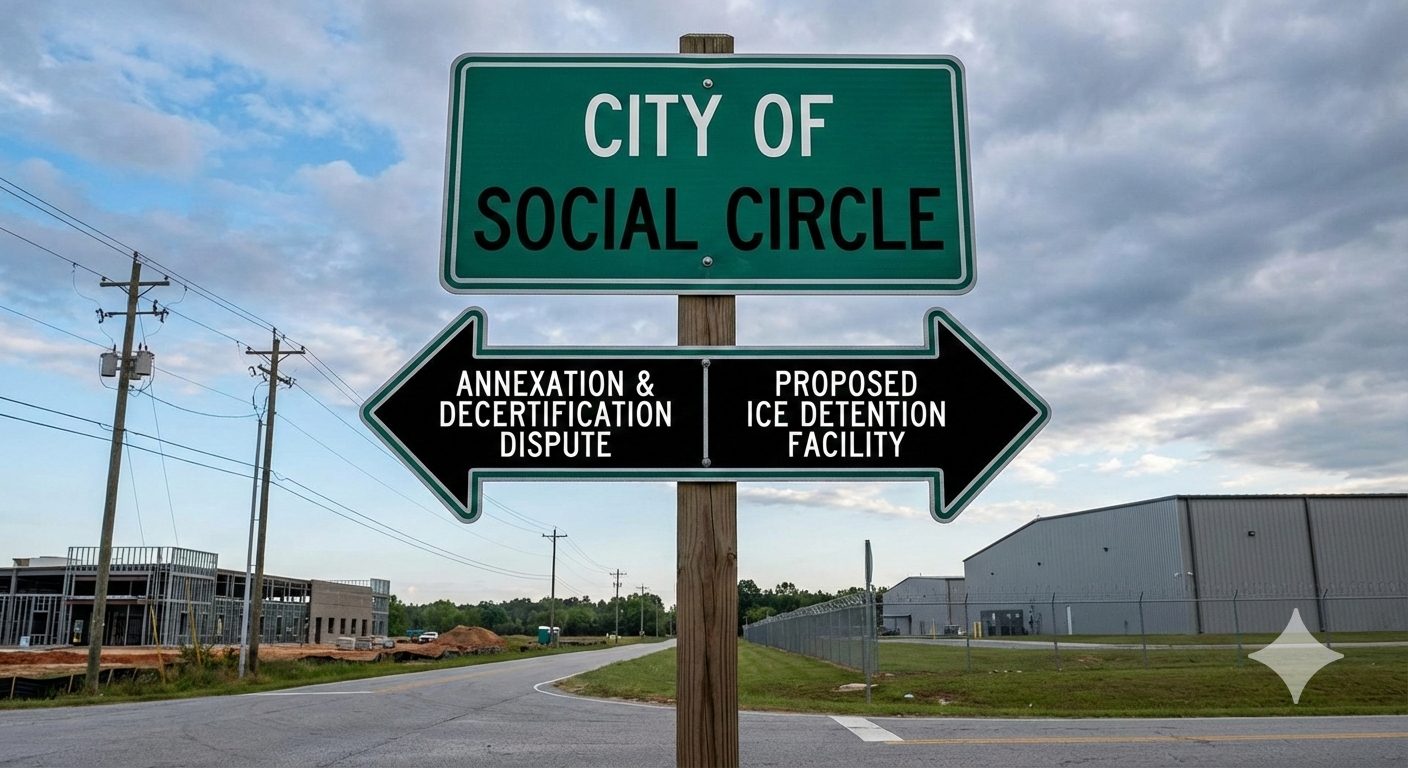
Georgia’s Department of Community Affairs decertified Social Circle as a Qualified Local Government effective September 21, 2026, for one year, after a fight with Newton County over a roughly 700-acre data center annexation. The city can’t tap DCA grants and loans for now, but police, fire, and utilities keep running, and the proposed ICE detention center is off the table. For homeowners: don’t panic-sell. For investors: watch the appeal and the warehouse sale before you buy land on the Newton side.
Let me be really clear with you right out of the gate.
Back in February I wrote about “double trouble” in Social Circle. A state decertification threat on one side. A massive federal detention facility on the other. People were nervous. My phone was ringing.
Eight months later? One of those threats became real. The other one disappeared. And here’s the thing nobody wants to hear: neither one changes the long game.
Headlines are short term. Real estate is long term. I’ve been doing this for 27 years and closed around 1,000 homes, and the people who win are the ones who stop reacting to the news cycle and start reading the actual facts. So let’s read the facts.
What actually happened to Social Circle’s state certification?
Here’s the story in plain English.
In September 2025, a property owner asked Social Circle to annex hundreds of acres near Strouds Creek in unincorporated Newton County. The plan: a data center with 14 buildings and an electrical substation. Newton County objected and kicked off arbitration. Social Circle approved the annexation before arbitration wrapped up.
The state did not love that. The Georgia Department of Community Affairs said the city didn’t participate in the process “in good faith.” The city fought back in Fulton County Superior Court, and the judge said DCA hadn’t issued a final decision yet. So DCA reissued the notice, and the decertification took effect September 21, 2026, for one full year.
The city says it’s appealing again. City Manager Eric Taylor’s message was basically: we’re a fully operational city, phones are answered, meetings continue, and public safety and utilities aren’t affected. And he’s right about that.
What does losing QLG status actually cost the city?
This is where people overreact, so stay with me.
Qualified Local Government status is the key that unlocks a big list of state-administered money. DCA publishes a fact sheet of programs linked to QLG status, and reports put it at roughly 20 grant and loan programs. Think community development grants and infrastructure financing, including loans through the Georgia Environmental Finance Authority (GEFA) that cities use for water and sewer.
Now the macro truth: the city says it has no pending DCA funding applications and no active state loan requests. So today, right now, the bleeding is minimal.
The micro risk is what happens if this drags past a year. Water and sewer capacity is what lets new neighborhoods get built. If Social Circle needs a big utility project and can’t get state help, that cost lands somewhere. And “somewhere” usually means the local tax bill.
“One year of decertification with zero pending applications is a speed bump. Three years of it is a pothole. Know the difference before you make a move.”
Is the ICE detention center still coming to Social Circle?
No. And this is the part of my February post that needs a real update.
Federal officials bought a roughly 1 million square foot warehouse on Hightower Trail for about $128 million with plans for a detention facility holding up to 10,000 people. The city raised serious concerns about water, wastewater, schools, roads, and public safety, and sued in May. In June 2026, the city announced that DHS was no longer pursuing the facility.
Then on October 7, 2026, ICE notified the city it’s proposing to sell the property. If no other federal agency claims it, the expectation is a sale through the General Services Administration’s property disposal process. No buyer and no timeline yet.
I covered the full timeline in my ICE detention center update for Walton County residents. Bottom line for real estate: a brand new, built-in-2024 warehouse going back to private hands could mean jobs and a property tax base again. That’s a better story than the one we were telling in February.
Should I sell my Social Circle home because of this?
Let me ask you something back. Did your reason for owning a home in Social Circle change?
You bought here for the small-town feel, the price point, the access to I-20, and the jobs coming into the region. None of that got decertified.
Look at what’s happening around you. Stanton Springs is still a major employment engine. Covington just landed a 128,000 square foot Target anchoring a new I-20 town center. Monroe is getting a $141 million DeltaX investment. That’s the macro. That’s what moves values over ten years.
Panic-selling into a soft headline is how people leave money on the table. If you’re thinking about selling, sell because your life changed. Not because a news alert scared you.
And if you want to know what your home is worth right now, not what Zillow guesses, start here.
What should investors and land buyers do right now?
Different story. If you’re buying dirt, you need to be more patient than everybody else, and patience is a superpower.
- Hold off on land along the contested Newton County border. The data center’s future is unclear, the appeal is unresolved, and zoning risk is real until this is settled.
- Watch the warehouse sale. Who buys 1365 Hightower Trail will tell you a lot about what the next five years of that corridor look like.
- Underwrite a higher tax bill. If state infrastructure money stays frozen, assume holding costs go up, not down. Run the numbers conservatively.
- Don’t ignore the neighbors. Developers who get spooked by uncertainty often pivot to Covington or Monroe. Make sure you’re looking there too.
What could go wrong from here?
I’m not going to sell you sunshine. Here’s my honest list of what could make this worse:
- The appeal fails and Social Circle doesn’t regain compliance after the one-year window, stretching the freeze on state money.
- A big water or sewer project comes due while the city is cut off from GEFA-type financing, pushing costs onto property owners.
- The Newton County dispute keeps dragging, and developers simply skip Social Circle for towns with less drama.
- The warehouse sits empty for a long time, which means no jobs and no tax revenue from a very large property.
And here’s what could go right: the city regains its status in a year, the warehouse sells to an employer, and the I-20 growth story keeps rolling. That’s the scenario I think about when I say buy and wait, don’t wait to buy.
So what’s the bottom line?
Stop consuming headlines and start consuming facts. The decertification is real, but its impact today is limited. The detention center is gone. The warehouse is heading back to market. And the jobs coming into this corridor didn’t go anywhere.
Homeowners: stay calm, keep an eye on what city council does next, and know your number. Investors: be patient on the Newton side and let the dust settle.
Want to dig deeper? Check out my Social Circle community page, the 2026 new construction guide for Loganville, Monroe, and Social Circle, and my September 2026 East Georgia market data. If you’re worried about your tax bill, here’s how to appeal property taxes in Georgia.
Got questions? Call or text me at 770-833-5965. I answer.
Frequently Asked Questions

Chris leads the Davis Team at Keller Williams with about 27 years of experience and roughly 1,000 closings across the Atlanta-to-Athens corridor, including Social Circle, Monroe, Loganville, and Covington. Call or text 770-833-5965 or email chris@eastgahomes.com. GA License #327023.
This article is for general information only and is not legal, tax, or financial advice. Details reflect public reporting as of October 9, 2026, and may change as appeals and property sales move forward. Consult a qualified attorney, tax professional, or financial advisor before making decisions. Davis Team, Keller Williams Realty. Each office independently owned and operated. Equal Housing Opportunity.